How Axioval fits together
This page opens the booklet's four ideas and shows what sits behind each one. The simple picture remains the same: shared names, reusable check recipes, completed checks, and a bundle that carries them safely. Technical names appear only where a tool builder needs them.

1. Vocabulary
A definition package can declare three independent concept catalogs:
| Concept | Purpose | Example |
|---|---|---|
ObjectTypeDefinition |
Reusable model-object type | IFC IfcWall |
PropertyDefinition |
Reusable property identity and value kind | boolean LoadBearing |
PropertySetDefinition |
Optional external container qualifier | Pset_WallCommon |
Each concept has a stable qualified ID and one or more ExternalName bindings.
The stable ID is what rules reference; adapters map it to each supported model
schema.
Important
PropertySetDefinition does not list or own properties. A property may
appear in multiple external containers. Container membership becomes
normative only when a selector or PropertyReferenceValue names a set.
2. Template
A RuleDefinition declares:
- a stable definition ID;
- a stable
capabilitythat applications explicitly implement; and - typed parameter definitions.
Show the Pkl template
["axioval:example.boolean-property-equals"] = new Definitions.RuleDefinition {
  id = "axioval:example.boolean-property-equals"
  capability = "axioval:capability.property-value-equals"
  name = new Types.LocalizedText { default = "Boolean property equals" }
  parameters {
    ["property"] = new Definitions.ParameterDefinition {
      id = "property"
      name = new Types.LocalizedText { default = "Property" }
      kind = "propertyReference"
      referencedValueKind = "boolean"
    }
    ["expected"] = new Definitions.ParameterDefinition {
      id = "expected"
      name = new Types.LocalizedText { default = "Expected" }
      kind = "boolean"
    }
  }
}
referencedValueKind closes a subtle type hole: this boolean template cannot be
bound to a string property.
3. Instance
A RuleInstance binds a known definition to concrete values and an applicability
selector. Instances are policy, the ABox-like layer, and belong in external
ruleset repositories. This schema repository contains them only under
examples/.
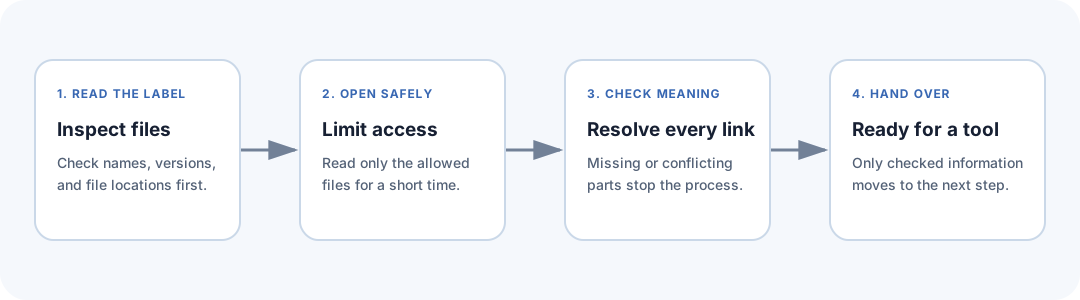
4. Package and normalization
axioval.json statically identifies the package and every definition entrypoint.
Only after all entrypoints are repository-confined and all candidate JSON is
semantically bound does the output become normalized interchange.
What Axioval does own
- Shared, stable names for building facts
- Typed, reusable descriptions of checks
- Declarative filled checks that can be shared as data
- A package contract that rejects incomplete or inconsistent input
What Axioval deliberately does not own
- Opening model files or following IFC relationships
- Calculating geometry
- Running executable rule logic supplied by a package
- Replacing an application's trusted internal model
- Trusting a package merely because of who owns its repository
Axioval describes meaning at the exchange boundary. Each application remains in control of model access, algorithms, execution, and trust decisions.