Safe package acceptance
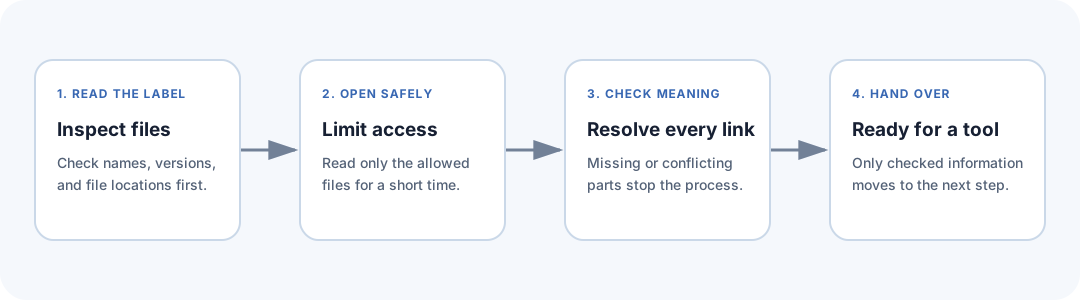
Before a shared bundle reaches a checking tool, Axioval opens it through a fixed series of safety gates. Each gate answers one plain question: are the files where they should be, can they be opened safely, do all references make sense, and does the result match the reviewed snapshot?
Every package follows the same path. A package owned by Axioval receives no extra permissions or trust.
Required files
Show the required files
The manifest must validate against
schema/registry-manifest.schema.json. Entrypoints are repository-relative Pkl
paths. Absolute paths, .. traversal, unknown fields, missing modules, and
non-Pkl entrypoints are forbidden.
Ordered trust boundary
The order is part of the security contract:
- parse
axioval.jsonas untrusted static data; - validate every field against the manifest JSON Schema;
- resolve all ruleset and definition paths inside the repository root;
- re-resolve a copied Pkl project with an empty cache and require its generated dependency lock to match the committed bytes;
- evaluate Pkl with repository-local, standard-library, and checksum-locked package modules; HTTPS resources are limited to the OpenBIM package metadata, stable release, and signed release-asset hosts, while arbitrary HTTPS, file, and environment resource reads remain forbidden;
- validate every candidate definition document;
- bind declared packages, source catalogs, citations, object types, properties, property-set qualifiers, templates, applicability groups, requirements, selectors, typed parameter values, and explanatory image assets;
- reject duplicate, missing, unknown, conflicting, malformed, or unsupported declarations; and
- compare semantically validated output with checked normalized snapshots.
Danger
Evaluator output before step 6 is candidate JSON, not normalized interchange. A successful Pkl process is not proof of a valid package.
Authoring and runtime separation
Pkl source may use imports, local values, and authoring helpers. Evaluation must lower all of that to declarative data. Applications execute only capabilities they already implement; they never execute package-supplied model-checking code.
Property-resolution contract
A property reference always names a canonical PropertyDefinition.
- With no
propertySet, adapters resolve it across supported containers. - With
propertySet, adapters require that exact canonical container relation. - Multiple incompatible resolutions are conflicts, not arbitrary winners.
referencedValueKindmust agree with the referenced property definition.
Property-set qualifiers do not own properties and are not execution folders.
Selector-valued parameters
A capability that needs a second object scope declares a parameter with
kind = "selector". The rule binds a complete selector using
SelectorValues.SelectorValue; it must not reduce the scope to a raw type name
or an executable callback.
Show a selector-valued parameter
The normalized value has type: "selector" and a nested selector object. The
binder recursively validates that object and resolves every object-type and
property concept through the loaded definition packages. Unknown concepts,
malformed operands, and unsupported value combinations fail closed.
Citation contract
Every ruleset and definition document declares its own source catalog. Citations
must resolve inside that catalog. Definition components, rules, and requirements
may cite a source directly; parameterCitations must name non-empty, unique
parameter IDs that the same rule actually binds. Citation IDs are unique within
their containing rule or definition component, and duplicate locators are
rejected.
Source URLs are optional. When present, they must be absolute HTTPS URLs without
embedded credentials. Publication dates use valid ISO YYYY, YYYY-MM, or
YYYY-MM-DD forms. Localized source titles and notes use the same fail-closed
localization contract as rule text.
A citation records provenance only. It must never alter selectors, requirements, evidence, pass or fail outcomes, legal status, or conformance claims. Store bibliographic metadata and pinpoint locators rather than copyrighted normative text.
Package image assets
Explanatory images are data, not executable extensions. Their paths must remain inside the package. Callers must provide the package root whenever a ruleset references images; the binder rejects image-bearing rulesets when that root is missing. It resolves every referenced file, checks the size, extension, declared media type, and file signature, and parses SVG as inert XML. Active elements, event handlers, external links, document types, processing instructions, style content, and foreign SVG content fail closed. Consumers should still apply their own image decoding and rendering sandbox.
Source and compiled forms
Pkl source is authoritative for editing. A registry may cache validated normalized JSON, but generated output alone is not proof that source is safe or valid. Cache keys should include the immutable source revision, schema version, Pkl version, and validator version.
Licensing and provenance
Package authors choose their own license and repository host. Registry listing does not transfer ownership or imply endorsement. Axioval-owned packages are ordinary packages validated through the same pipeline.